
Becky Hammon said, “No.” Maybe the Aces’ parallel is in Atlanta - not Indianapolis
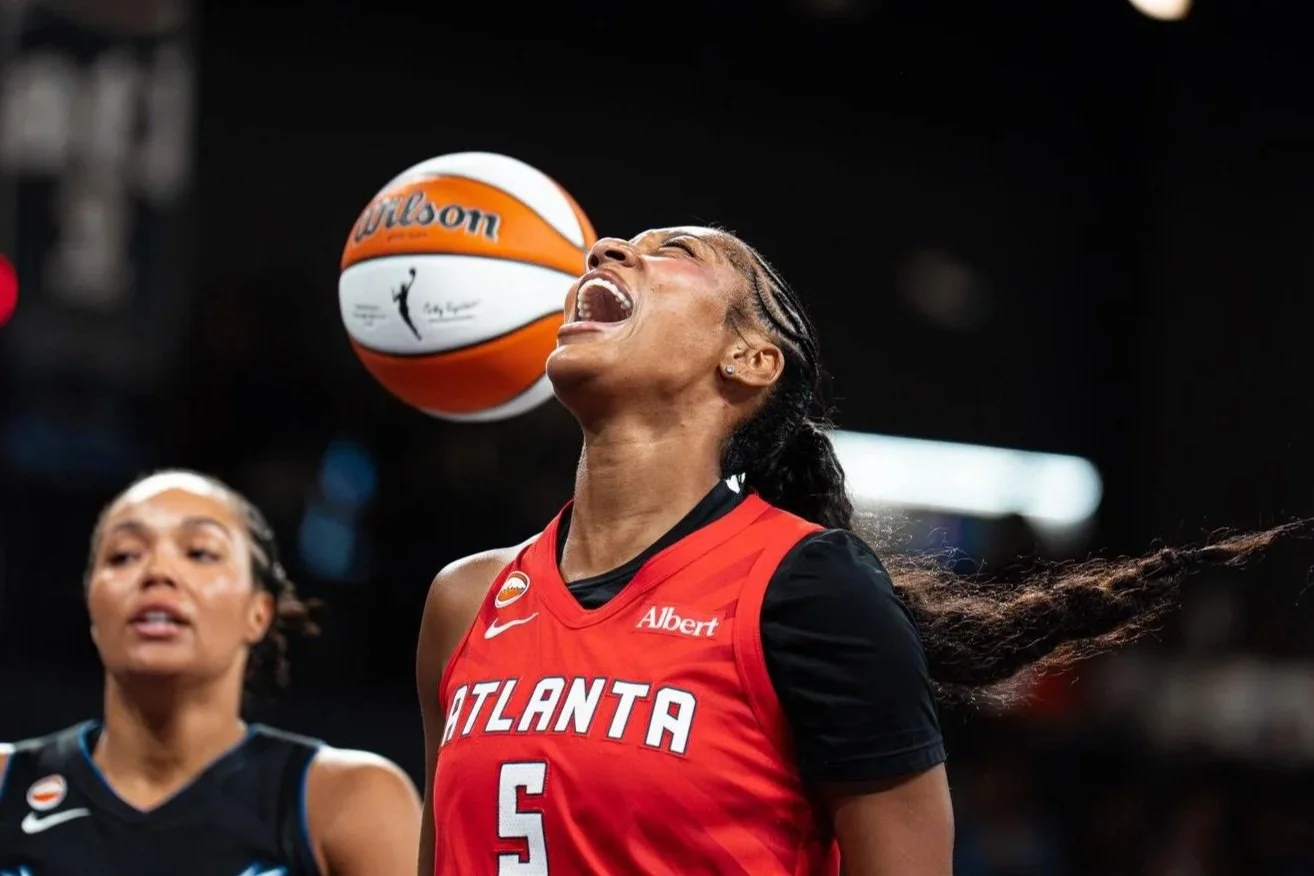
Atlanta Dream star Angel Reese averaged a career-high 16.4 points and a league-leading 12.1 rebounds this season, setting WNBA single-season records with 521 total rebounds, 206 offensive rebounds and 32 double-doubles. Reese dominated Monday, scoring 30 points and grabbing 16 rebounds in Atlanta's 79-65 win over the Golden State Valkyries, evening the best-of-seven series at one game apiece. PHOTO CREDIT: Atlanta Dream
By W.G. RAMIREZ
Becky Hammon on if she sees parallels between the Aces that she took over in 2022 and this Fever team, both having multiple top picks: "No." *A'ja reacts* "I think that team has great potential but... it's different." https://t.co/BWTnreOeU8
— Underdog WNBA (@UnderdogWNBA) October 2, 2026
LAS VEGAS — Becky Hammon didn't need a lengthy explanation.
When asked earlier in the WNBA playoffs whether she saw parallels between the Indiana Fever and the Las Vegas Aces team she inherited before the 2022 season, Hammon responded in one word.
"No."
A'ja Wilson, seated beside her, laughed. Others in the room chuckled. The exchange quickly circulated on social media, with Hammon eventually acknowledging Indiana's potential while emphasizing that the situations were different.
But perhaps the more interesting question wasn't whether Indiana resembled Las Vegas.
Perhaps it was whether anyone had bothered to look toward Atlanta.
Eight years after Wilson arrived in Las Vegas and became the cornerstone of a championship organization, Angel Reese is emerging as a transformative presence for the Dream.
She's changing expectations. She's changing the team's identity. And she's showing how an established group of talented players can become far more dangerous when the right personality joins them.
Monday night, with the WNBA Finals threatening to slip away, Reese delivered 30 points and 16 rebounds in Atlanta's 79-65 victory over the Golden State Valkyries, evening the best-of-seven series at one game apiece.
It wasn't merely a performance that saved Atlanta from a two-game deficit.
It was the kind of performance that makes you wonder whether you're witnessing the beginning of something much bigger.
Championship pedigree doesn't begin in the WNBA
Long before Wilson became the face of the Aces, she understood what it meant to carry championship expectations.
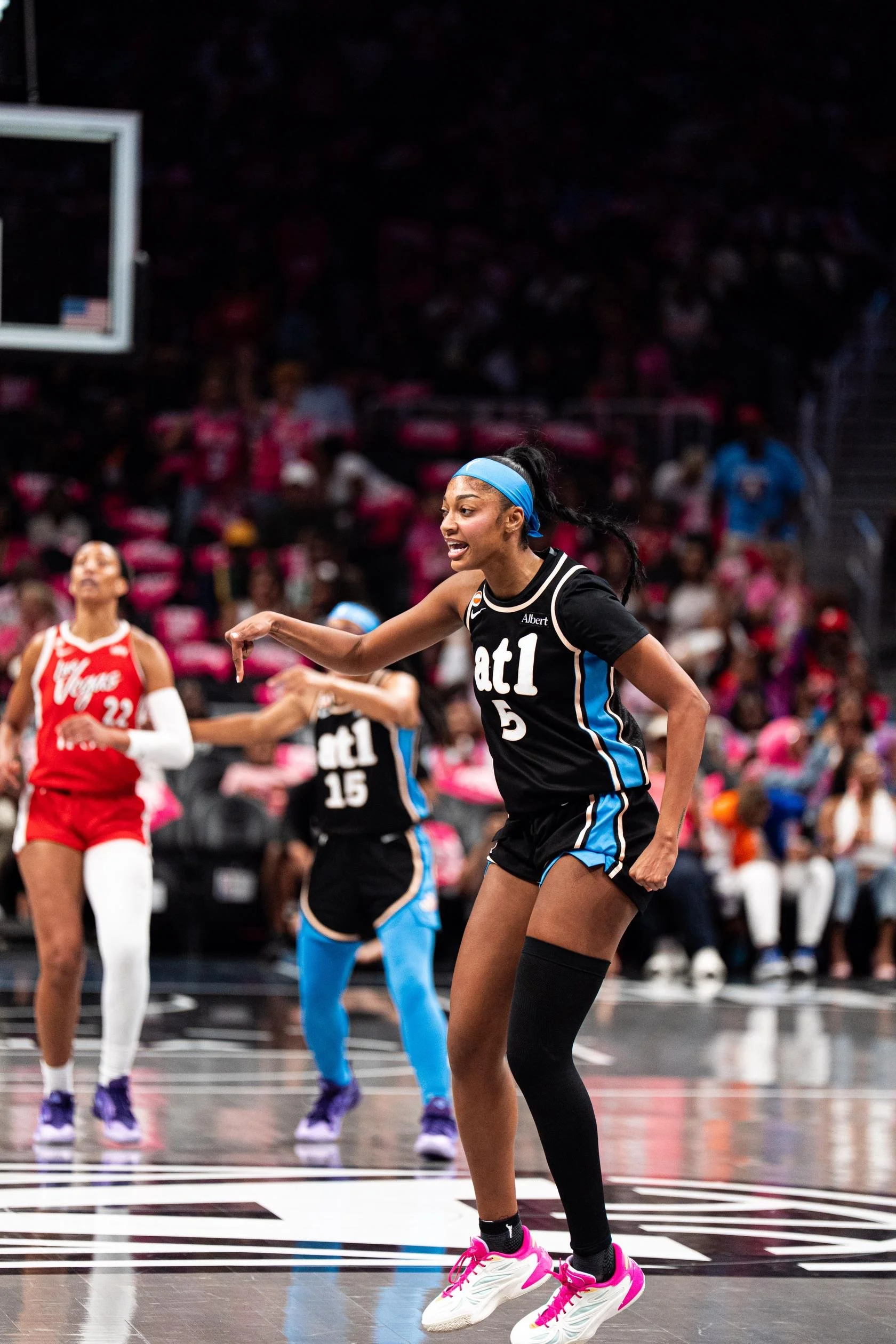
Are there are similarities between A’ja Wilson (22) and Angel Reese (5), when it comes to their roles with the Aces and Dream, respectively, and the paths the teams have taken to the WNBA Finals? PHOTO CREDIT: Atlanta Dream
Wilson led South Carolina to its first NCAA national championship in 2017, earning Final Four Most Outstanding Player honors and establishing herself as one of the program's most influential players.
Reese knew that feeling, too.
Six years later, she helped lead LSU to its first national championship, earning the same individual honor after a tournament run that elevated her national profile and reinforced her reputation as an uncompromising competitor.
Different schools. Different personalities. Different paths to professional basketball.
But one unmistakable similarity: Neither arrived in the WNBA needing someone to explain what it took to win a championship.
Wilson entered the league as the No. 1 overall pick in 2018, immediately becoming the centerpiece of a Las Vegas franchise that began its first season after relocating from San Antonio. She averaged 20.7 points and 8.0 rebounds as a rookie, giving the Aces a foundation to build their future on.
Reese's arrival in Atlanta followed a different route. Chicago selected her with the seventh overall pick in 2024, and she spent two seasons with the Sky before the Dream acquired her in April for two future first-round draft picks.
The investment immediately paid dividends.
Reese averaged a career-high 16.4 points and a league-leading 12.1 rebounds this season, setting WNBA single-season records with 521 total rebounds, 206 offensive rebounds and 32 double-doubles.
She also became the first player in Dream history to win Defensive Player of the Year.
Wilson was an emerging superstar when Las Vegas began building around her. Reese arrived in Atlanta already established as one of the league's most disruptive interior players.
Both brought championship credentials and joined franchises with talented players already occupying important roles.
That's where the organizational similarities become particularly interesting.
When a superstar arrives, everyone adjusts
When Wilson joined the Aces in 2018, Las Vegas wasn't lacking talent.
Kayla McBride was an established All-Star. Kelsey Plum had been the No. 1 overall pick the previous year. Dearica Hamby had spent three seasons with the organization in San Antonio, while Moriah Jefferson was another former lottery selection.
The challenge wasn't simply finding another outstanding player.
It was figuring out how all those pieces could function together.
Wilson immediately became the offense's focal point, but the transformation didn't happen overnight. Las Vegas finished 14-20 in her rookie season, improved to 21-13 in 2019 and eventually developed into a championship contender under Bill Laimbeer.
By the time Hammon arrived in 2022, the franchise had added another No. 1 overall pick in Jackie Young, Plum had evolved into an elite offensive weapon, and Wilson had established herself as one of the league's most dominant players.
The Aces won championships in 2022 and 2023, validating years of roster development, individual sacrifice and organizational patience.
Atlanta's circumstances are different, but the underlying challenge is familiar.
Atlanta's veterans aren't stepping aside. They're stepping up.
Allisha Gray was already one of the league's premier two-way guards. Rhyne Howard, the No. 1 overall selection in 2022, had developed into a dangerous scorer and perimeter defender. Jordin Canada supplied experienced point guard play, defensive pressure and leadership.
None needed Reese to validate their careers.
But her arrival gave Atlanta something it hadn't had at the same level: a relentless interior presence capable of controlling possessions through rebounding, physicality, and defensive disruption.
And importantly, those established veterans haven't disappeared.
When Angel Reese wants the ball you get her the ball 😤 She absorbs the contact and scores through it for the and-1! ATL-GSV | USA Network | Peacock | #WNBASeason30 | #2026WNBAFinals Tap to watch: https://t.co/FUPSqCIaOU https://t.co/AH154fCnZM
— WNBA (@WNBA) October 20, 2026
Gray scored 18 points Monday. Canada contributed 13 points, 10 assists and seven rebounds. Despite foul trouble limiting her offensive production, Howard set a WNBA Finals record with six steals.
Together, they helped Atlanta force 19 turnovers and convert them into 24 points.
The Dream shot just 33.9% from the field, yet won by 14 points because they dominated other areas of the game.
That's not simply star power.
That's a team developing multiple ways to win.
"We feed off her energy," Canada said of Reese. "She was talking to us the whole game, keeping us confident."
The significance wasn't simply that Reese had become Atlanta's most imposing presence. It was that an established veteran acknowledged how much the team drew on her leadership.
That is the kind of chemistry championship organizations must develop, no matter how much individual talent they assemble.
The difference is Atlanta's accelerated timetable
Here's where the comparison becomes particularly compelling.
The Aces needed four seasons after drafting Wilson to win their first championship in 2022. Their progression included roster changes, playoff disappointments and the eventual arrival of Hammon, whose offensive philosophy helped unlock the championship potential already present.
Atlanta might not require nearly as much time.
Under Karl Smesko, the Dream finished 30-14 in 2025, establishing themselves among the league's best teams before suffering a first-round playoff elimination.
The organization already had a winning foundation when Reese arrived.
Rather than asking a young superstar to rescue a struggling franchise, Atlanta acquired an established player who could address specific weaknesses on an already competitive roster.
The results have been substantial.
The Dream again finished 30-14 this season, ranking second in defensive rating and third in net rating. Reese's presence changed how they controlled games, with her rebounding helping Atlanta limit opponents to a league-low 9.5 second-chance points per game.
Monday's performance demonstrated what happens when those defensive strengths are accompanied by an overwhelming individual offensive effort.
One game, one statement, one emerging leader
Reese scored 30 points on 10-of-16 shooting, becoming the youngest player in WNBA Finals history to record at least 30 points and 15 rebounds in a game.
Only Jonquel Jones and Breanna Stewart had previously accomplished that statistical combination on the championship stage.
Perhaps more revealing was how Reese responded after going scoreless in the second half of Atlanta's 68-64 Game 1 loss.
"I let my team down last game, not really contributing as much as I could in the second half," Reese said. "I wanted to make sure that I came out tonight and left my mark and do what I could to win, and I think I did that tonight."
That is the accountability of a player who understands that individual recognition means little without collective success.
Smesko recognized something different about Reese before the game, recalling the determined expression he saw when they made eye contact near the locker room.
"I like this look," he told her.
His instincts proved correct.
Reese delivered the most important performance of her professional career, and her coach later described it as "a superior performance."
Championship culture is about more than championships
Leadership isn't exclusively about who scores the most points or whose name appears first on a roster.
It's about whose presence changes what everyone else believes is possible.
Reese is showing she has the personality and competitive intensity to become that kind of leader in Atlanta.
Whether that translates into multiple championships is a different question entirely.
There are important reasons not to rush the comparison.
Wilson has become one of the most accomplished players in WNBA history, with an offensive repertoire and sustained individual dominance that Reese has not yet matched.
Their games aren't identical, nor are their professional circumstances.
And Las Vegas' success wasn't inevitable. It required years of development, additional personnel decisions, coaching changes and a supporting cast willing to evolve.
Atlanta still has to prove it can sustain its current success, navigate future roster decisions and win the championship that remains directly in front of it.
A dynasty isn't declared. It's built.
One Finals victory doesn't establish a dynasty.
But it can provide a glimpse of what a championship foundation looks like.
Very cutesy, very demure first Finals dub Win Cam 🅰️💅 See y’all back in the A! Win Cam | @lendistry https://t.co/BMTigdqZ5x
— Atlanta Dream (@AtlantaDream) October 20, 2026
For a franchise that entered this series winless in 10 previous Finals games across three appearances, Monday's breakthrough carried significance beyond tying the series.
Atlanta finally demonstrated that it could win on the league's biggest stage.
And Reese, in her first season with the Dream, was the central figure.
That distinction matters.
"It's just a start," Reese said. "We have the city behind us. It's just the first toward who Atlanta is and who Atlanta is going to be the next couple of years."
Those aren't the words of someone satisfied with winning one Finals game. They're the words of a player already thinking beyond the immediate celebration, toward what her franchise might become.
The 2018 Aces were trying to discover what they could become. The Dream of 2026 already know they're good enough to compete for a championship.
Now they're finding out whether they have the ingredients to become something enduring.
The next test comes Wednesday, when the series shifts to Atlanta and a sold-out State Farm Arena for Game 3.
For now, the similarities are intriguing enough to keep us guessing.
Two national champions. Two powerful personalities. Two franchises with talented players learning how to maximize their collective strengths.
And perhaps two organizations whose most important championship chapters began when the right player arrived at the right moment.
Maybe Becky Hammon was right when she said, “No.”
Maybe she was simply asked about the wrong team.
