
Angel Reese may be the final piece in Dream's championship puzzle
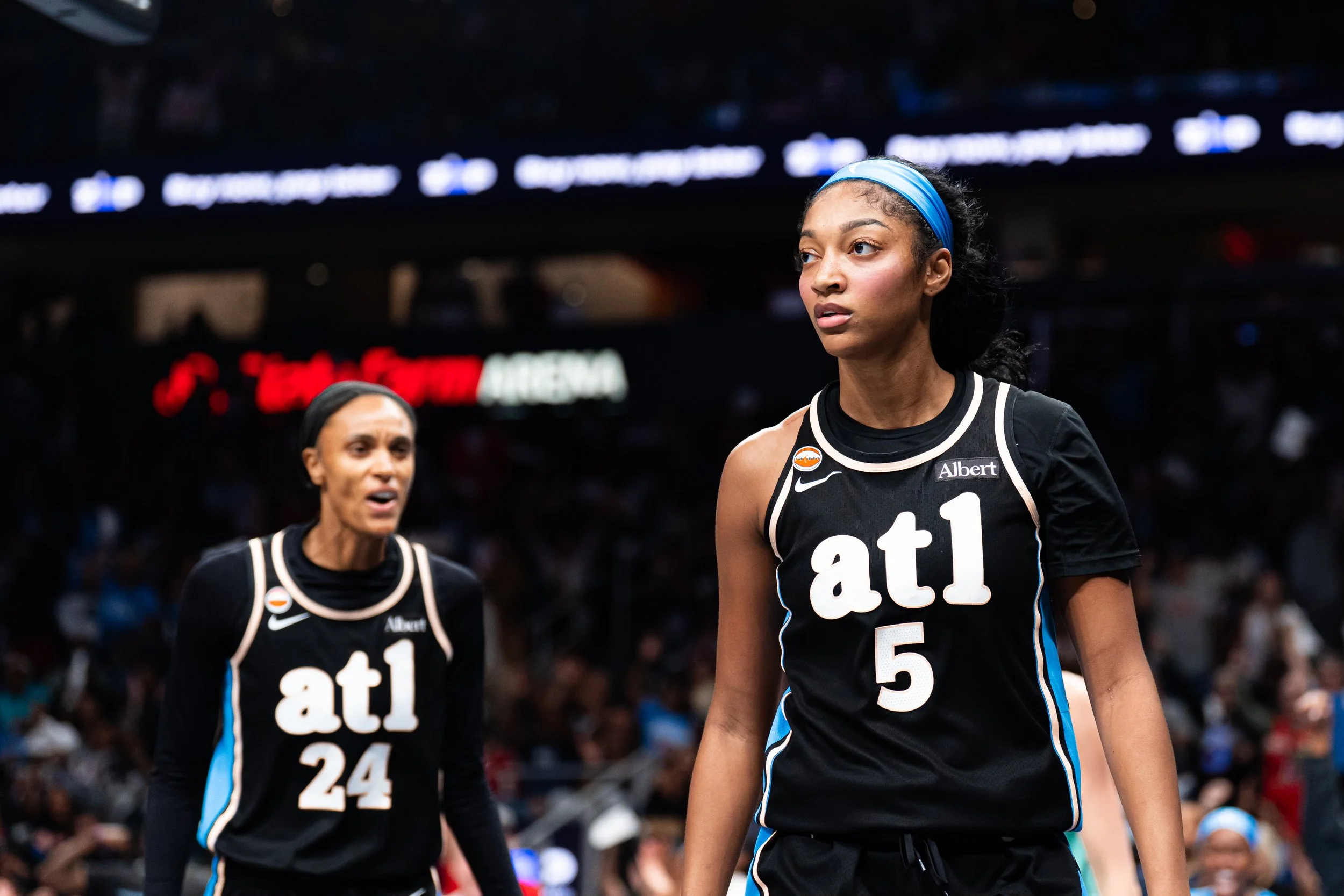
Three years after leading LSU to an NCAA championship, Angel Reese is helping fuel Atlanta's pursuit of a title, bringing championship experience to a team looking to turn regular-season success into postseason glory.
PHOTO COURTESY: Atlanta Dream
While the Dream's emergence is about more than one player, the former LSU national champion has transformed the Dream's interior presence and has them knocking on the door of the WNBA Finals
By W.G. RAMIREZ
Angel Reese already knows what it takes to win a championship.
The question now is whether she can help the Atlanta Dream accomplish something the franchise has never done.
Three years after leading LSU to the NCAA national championship, Reese finds herself at the center of another potentially historic run, this time with an Atlanta team that may have found the final ingredient to turn regular-season success into postseason glory.
Wednesday's 101-98 overtime victory over the New York Liberty moved the Dream within one victory of their first WNBA Finals appearance since 2013. Reese delivered 23 points, seven rebounds and two blocks, including four crucial free throws in the closing moments of regulation and overtime.
Atlanta's emergence isn't simply the story of one superstar arriving and changing everything, though.
It's about a talented foundation already in place, a championship-tested veteran joining the equation and a young player whose relentless approach to basketball may have helped everything come together.
But was Reese the missing piece? Or is she the player who finally helped the existing pieces fit?
Championship experience meets a historic season
Reese earned her championship credentials long before she arrived in Atlanta.
At LSU, she became the emotional and physical centerpiece of a national championship team, embracing the responsibilities that come with playing under pressure and understanding that winning often depends on doing the uncomfortable work.
That mentality followed her through two seasons in Chicago before Atlanta acquired her in April.
Her first season with the Dream became historic.
Reese averaged a career-high 16.4 points and a league-leading 12.1 rebounds, establishing WNBA single-season records with 521 rebounds, 206 offensive rebounds and 32 double-doubles. She also set a single-game league record with 26 rebounds.
The accomplishments culminated in the WNBA Defensive Player of the Year award, making Reese the first player in franchise history to receive the honor.
But statistics only tell part of the story.
Reese gave Atlanta an interior presence capable of controlling possessions, challenging opposing frontcourts and creating second-chance opportunities. Her physicality complemented a roster already loaded with perimeter talent.
Wednesday offered another example of her influence, although her most important contributions came nowhere near the rebounding column.
After New York erased Atlanta's late regulation advantage, Reese converted two free throws with 14.5 seconds remaining to give the Dream a three-point lead.
The Liberty forced overtime anyway.
Then, with Atlanta protecting a one-point advantage in the final seconds of the extra period, Reese returned to the line and calmly made two more.
That, after ESPN play-by-play man Ryan Ruocco declared near the end of regulation that the three-time WNBA All-Star was the right person to foul because of her poor shooting from the charity stripe.
Did she shoot 72.1% from the line during the regular season?
Yes. But Wednesday’s critical moments represented more than routine execution. They reflected preparation.
"Trust my work," Reese said afterward, explaining that she shoots free throws after every practice, no matter how late she stays in the gym.
The routine includes making 10 consecutive attempts before leaving.
With the season's biggest moments unfolding around her Wednesday, that work paid off.
The foundation was already in place
It would be unfair to portray Reese as the sole reason Atlanta has reached this position.
The Dream won a franchise-record 30 games last season, earning the Eastern Conference's top seed before suffering a disappointing first-round playoff elimination.
The talent was already there.
Allisha Gray provided scoring consistency and versatility. Rhyne Howard supplied perimeter firepower. Jordin Canada controlled the offense while applying relentless defensive pressure. Naz Hillmon brought physicality, rebounding and an ability to contribute without demanding attention.
Reese didn't replace those strengths.
She enhanced them.
Atlanta won 30 regular-season games again, but adding Reese changed the team's interior identity and defensive possibilities.
The Dream also added DeWanna Bonner, a two-time WNBA champion whose postseason experience has become increasingly valuable.
Bonner scored 23 points in Atlanta's Game 1 win over New York, helping the Dream overcome Gray's left-hand injury.
Gray's absence in Game 2 presented another test.
Atlanta responded with five double-figure scorers, including Canada's 23 points and eight assists, Howard's 18 points, Hillmon's 12 and Isobel Borlase's 11 off the bench.
Every contribution mattered.
Reese emphasized that responsibility afterward, explaining that teammates must trust the person beside them and respond when someone important is unavailable.
The sentiment echoed Canada's postgame message that every player must accept responsibility, whether their opportunity lasts two minutes or 40.
That collective approach has become central to Atlanta's identity.
The Dream no longer depends on one player producing an extraordinary performance. They have developed enough versatility to win through different combinations, with coach Karl Smesko finding ways to maximize a roster whose strengths complement one another.
Wednesday's victory was the clearest illustration yet.
A championship mentality is taking shape
Atlanta's Game 2 victory wasn't particularly comfortable, and perhaps that made it more revealing.
The Dream watched a late lead disappear when Marine Fauthoux buried a tying 3-pointer with 10.3 seconds remaining in regulation.
They opened overtime by scoring five consecutive points, only to surrender the next eight.
When Breanna Stewart put New York ahead 98-97, Atlanta faced another moment that could have shifted the series.
Instead, Hillmon delivered the go-ahead basket with 20.8 seconds remaining, Reese added the decisive free throws and the Dream survived.
Smesko said the message entering overtime was simple: execute immediately and trust the preparation.
"We just had a message that we thought we could be the best team over the last five minutes; let's start off by executing the first couple plays," Smesko said. "Everybody was locked in on what those plays were, and they went out there and executed them."
Reese credited the same togetherness.
"We really stayed together and played together, and that's how we won," she said.
Yet the Dream understand that a 2-0 series advantage guarantees nothing.
Canada made that clear following Wednesday's victory.
"We can't go there thinking just because we have a 2-0 lead that we can cruise," Canada said. "We have to keep doing what we're doing. We have to keep pushing the pace, keep being physical, keep attacking, keep being us."
All Things Perspective
It's the perspective of a team beginning to understand the difference between possessing championship talent and developing a championship mentality.
Reese's experience at LSU cannot guarantee a WNBA title. Neither can Bonner's championship resume, Atlanta's regular-season accomplishments or its current postseason advantage.
But the combination has given the Dream something they have spent years trying to build.
Howard, Gray, Canada and Hillmon established the foundation. Bonner contributed experience and leadership. Smesko has helped shape their collective identity.
And Reese has supplied a relentless interior presence and championship-tested mentality that may have pushed Atlanta closer to its ultimate objective.
The Dream are one victory from thea Finals, but the larger ambition remains unfinished.
Perhaps Reese wasn't the missing piece because Atlanta lacked championship talent.
Perhaps she was the piece that helped a championship-caliber roster finally understand how all its strengths could fit together.
